Why Do So Many People Misread OpenClaw?
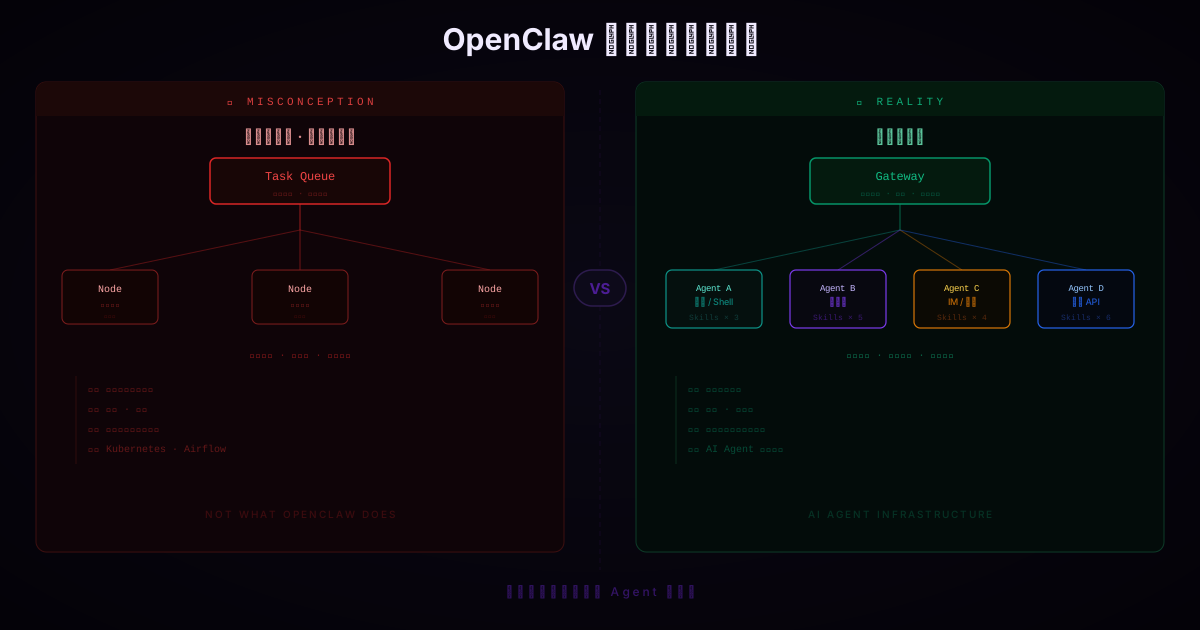
The first time someone reads about OpenClaw’s architecture, they almost always reach the same conclusion:
- There’s a Gateway
- It connects to multiple nodes
- Those nodes can run on different machines
And so the obvious inference follows:
“Oh, so it’s just a task scheduler / load distributor, right?”
This is one of the most common — and most persistent — misconceptions about OpenClaw.
Let me be clear from the start: OpenClaw is not a load balancer, and it never intended to be.
The problem it solves operates on an entirely different dimension from systems like Kubernetes or Airflow.
What Was OpenClaw Actually Built For?
OpenClaw wasn’t created to answer the question “how do we distribute tasks across more machines?” It was built around a more grounded, practical problem:
How do you get AI to work for you locally — reliably, continuously, and under your control?
Before OpenClaw, large language models existed in two main forms:
- Chatbots: Single-turn interactions. Use it once, move on.
- Script-based tools: Point capabilities that don’t compose into long-term collaboration.
OpenClaw targets a third form:
An AI Agent that’s online 24/7, understands context, can call tools, and operate across systems.
To get there, it chose a deliberately engineering-driven architecture:
- A long-running control plane (the Gateway)
- Multiple Agents with clearly bounded responsibilities
- Agents execute real-world actions through Skills
From day one, the focus was on how capabilities are organized — not how compute is scheduled.
What Does the Gateway Actually Do?
The word “Gateway” does invite confusion. It sounds like a dispatch center.
In practice, it handles exactly three things:
Session and identity management: Maintains user connections, context boundaries, and permissions.
Intent recognition and routing: Determines which Agent should handle a given instruction, and which Skills to invoke.
Result aggregation and response: Returns the Agent’s output back to the user.
The key thing to understand:
The Gateway does not execute tasks. It doesn’t split tasks. It absolutely does not do load balancing.
Think of it less like a scheduler and more like a switchboard operator — its job is to connect the right call to the right person, not to manage a production pipeline.
Agents: Not Compute Nodes, But Capability Nodes
In a scheduling system, “nodes” typically mean:
- CPU and memory resources
- Dynamically schedulable units
- Interchangeable, scalable, replaceable
In OpenClaw, “Agent” means something entirely different.
An Agent is an execution unit with a defined role and a bounded set of capabilities:
| Agent | Responsibilities |
|---|---|
| Agent A | File system + Shell + local scripts |
| Agent B | Browser automation + web interaction |
| Agent C | IM / email / notifications |
| Agent D | Business APIs / ERP / CRM |
The defining characteristics: clear division of labor, stable responsibilities, always online.
👉 Multiple Agents ≠ Parallel compute 👉 Multiple Agents = Collaborative roles
Skills Are the Real Integration Layer
If OpenClaw has anything that resembles a “platform,” it’s Skills.
A Skill is fundamentally a capability contract: it defines inputs, outputs, and side effects. Agents load and execute them.
“System integration” in OpenClaw means:
Wrapping different systems, machines, and tools into clean, well-defined Skills. Not slicing a task into N pieces and throwing them at N machines.
What’s the Fundamental Difference From Actual Schedulers?
One sentence:
Schedulers care about where tasks run. OpenClaw cares about how things get done.
| Dimension | OpenClaw | Kubernetes / Airflow |
|---|---|---|
| Core goal | AI task execution | Resource / task scheduling |
| Task type | Continuous, interactive | Discrete, batch |
| Parallelism | Primarily sequential | High-concurrency parallel |
| Node meaning | Capability role | Compute resource |
| Load balancing | ❌ Not a feature | ✅ Core capability |
| Auto-scaling | ❌ | ✅ |
If you try to run ETL pipelines, batch jobs, or distributed compute on OpenClaw, you’ll hit a wall — because that’s not the problem it was designed to solve.
One-Sentence Summary
Don’t think of OpenClaw as a scheduler. Think of it as a capability orchestrator.
It’s not solving “how do tasks run faster.” It’s solving “how does AI actually get things done.”
Once you internalize that:
- It’s not a Kubernetes replacement
- It’s not competing with Airflow
- It’s a new category: AI Agent infrastructure
— Jerry, Founder, CoDevAI